Latest Releases

Showing posts with label DJing. Show all posts

Thursday, 16 February 2017

10 DJ Tactics For When People Won't Dance

For good DJs, an empty dancefloor is not a problem, it's an enjoyable challenge of DJing.

Any experienced DJ, no matter how good or professional, has encountered dancefloors that just refuse to react as expected.

Sometimes, you're confronted with a crowd that it seems just won't dance, no matter how hard you try. It can be confusing to you how one night girls can be dancing on top of the bar gyrating to your tunes and giving you flirty smiles when the next week you seem to have weird, serious looking people and zero energy on the dancefloor, no matter what music you play.

It's not your fault!

First, understand that there are a number of different circumstances that can change the mood and feeling of your night unexpectedly. You as a DJ have to be ready for them and know how to react to this when it happens.

Events taking place in the town or city that you're playing at, door policy and even the weather can influence the crowd that turn up to your nights.

Just as a sudden surge in warm weather and sunshine makes people feel happy, energetic and horny, a blast of rain can do the opposite and take the mojo out of your night.

Big events in town related to fashion, sports or business may all mean you have to adapt to the crowd and go outside of your comfort zone to make people dance.

An overly zealous door policy can see the real party animals getting refused entry and your dancefloor filling up with people who don't seem to care about your music.


All this can be a challenge for your usually lively dancefloor! So what can you do about it as a DJ? Well, the first thing is to relax. There are a number of ways of dealing with the floor that won't dance, so there's no need to panic: as a DJ, you can try all of them. Here they are:

1. Have your secret weapon tunes ready

Create a list of tracks you can play as secret weapons. You should make a rule to only ever drop these when you have a really limp crowd or people who only dance to cheese. Make sure that around half of these are well-known favourites and the other half discreet dancefloor bombs that you've found yourself.

Don't ignore top 40 hits or old party hits because you don't like them. You may hate Cyndi Lauper's Girls Just Wanna Have Fun or Katy Perry's latest chart hit but these tunes could spark life into a lame night for you.

If you really find it painful to play music that's considered cheesy, then find or make remixes of well-known hits to play instead. Justice's remix of the Britney Spears song Me Against The Music is a great example of where cool electro meets top forty hit. That way you can be cool and play to the top 40 crowd at the same time!

2. Find and know more music genres

To be able to react to different people you should be getting into different genres. Mastering one genre is fine but don't be a one trick pony. You really need to be a pro at knowing other genres too in case your crowd don't react quite as you like.

Organise your tunes so that you can flip to a different genre or sub-genre if your crowd aren't digging the music that you're blasting out.

Get to know and enjoy tunes of at least two or three other genres you are familiar with, identify the tracks people will dance to and try them out. You'll see this come in useful time and time again to wake up the energy on the floor.

3. Find tunes that you know girls dance to


When it comes to the dancefloor it's all about the girls. Why is this? Because when girls dance, not only do they look good but you'll see an army of boys follow them straight onto the floor to try to bust out a few hot moves.

These boys don't always care what music is playing, they'll just head to the floor when they see a hot girl dancing to try to cut some shapes and impress her.

Use your experience to make a list of proven girlie tunes, then release them when you feel the dancefloor needs a boost. You'll see those ladies liven up the dancefloor pretty quickly. Then watch the boys follow them blindly onto the floor, and chuckle to yourself.


4. Relax and become one of the crowd


Get out of your DJ box and mingle with the crowd. your enthusiasm and friendliness can be a vital ingredient in getting people relaxed and then dancing.
All too often, we take ourselves a bit seriously as DJs. After all, aren't we there to play some cool trainspotter tunes that no one else has discovered? Don't you want to show that you know the best cool music around that no other DJ can get? You know, showcase some real hardcore DJ tunes with effects. Yeah!

Well... yes and no. You can educate people and take them on an adventure of musical discovery. But what people really care about isn't you in your booth. It's them and their night out. That's right. All they want to do is enjoy themselves and have a good time.

Learn to relax when playing out and don't take yourself seriously. Enjoy playing out. Have a drink if it helps you get onto the same wavelength as the people there. Chat to some people near you, head out of your booth and mingle a bit. You'll feel better and less tense to be part of the crowd.

Very often, as soon as you relax you'll find yourself automatically playing tunes that people dance to instead of ones that you thought you "should" play.

5. Think positively

Without trying to sound like a sales guru trainer, you have to be able to react positively as a DJ.

Being very positive really does help you when DJing as you'll need to constantly boost yourself if the night isn't going as well as planned. Moaning that your crowd are a bunch of losers when they don't react to what you play won't help you at all and it certainly won't make them dance!

If they're looking like they just came from a funeral when you drop your peak time hits just smile, be cool and tell yourself you're going to turn it around. My DJ sets became better when I started to think this way.

You need to develop a reflex reaction to negative situations on the floor. Tell yourself that everything is going to go well and you'll find the music that makes them dance no matter what's happening.


6. Look at your dancefloor

Looking at who is out to have a good time tonight helps you gauge the atmosphere and get a feel for the kind of music they may like. Are your crowd more black, white, Asian or Latin?
Without generalising about their music tastes, the way people look can help you get an idea of what will make them dance. Are there more boys or girls? Straight or gay? Drunk or high?
Using your common sense to make decisions about what tunes to play, try them out and keep looking up at them from time to time to get a feel for how it's going.


7. Take a request

You may not like to take requests, but they can be just the thing if you need to get the dancefloor going in a hurry.
We all know DJs who refuse to take any requests but you should think about being open to listening to what people say if no one seems to be enjoying themselves. If you have a group of seven pretty girls who promise to dance if you play Basement Jaxx, then why not play it?
You can be sure it'll get some others on the floor too once a group starts to dance. Their request might be what you need to open up a bit and get the musical juices flowing.

8. Play out as often as possible

As a general rule, playing anywhere from the local hairdresser to the coolest club in town to the old people's home around the corner will help to expand your musical knowledge and develop your DJ intuition. So go ahead, programme your friend's party playlist, play out anywhere and observe how people react in certain situations.

You'll learn much more about how music makes people react according to their mood, persona and the time of night or day.

9. Invite your friends along

If you're not already doing this, then you should be. Make sure you do more than create a simple event on Facebook. Many people receive several Facebook event invitations per day and pay little attention to them. Be better than this and send only personal notes to more influential, musically minded friends of yours and those who know a few people who like a night out. People react far better to a personal message.

Invite plenty of girls that you know who are likely to enjoy the night. Rotate your groups of friends to keep them fresh so you invite new ones each time you play.
In smaller venues, having your loyal group of dancing friends present can save your life for getting people on the floor.

10. Start dancing yourself

If the crowd really do seem to be a lame bunch and refuse to move any parts of their body no matter what dancefloor bombs you drop, then start dancing away yourself in your booth. After all, you've done all you can, so you may as well just enjoy yourself!

Grab a drink, put on some great tunes and dance away to them.

The DJ's energy is infectious and for some people; just seeing you enjoy yourself will make them want to have a good time.

Conclusion

Making people feel good and getting them dance is what makes you successful as a DJ. Nothing else is more important.
Preparing and knowing your music well and being ready to play outside of your comfort zone is great preparation for being able to react and adapt to a crowd.
If you've got your music organised and you know it well, then you should be able to relax, enjoy your mix, try out different tunes and make the girls dance. If you find out things don't go as well as expected, the job is to get into the minds of your crowd and you'll be able to get them warmed up and dancing in no time, whoever they are.

Credit:- http://www.digitaldjtips.com
Read »

Beginners' Guide To Keylocking

The yellow musical note in Traktor Pro 2 that tells you your track is "keylocked" - but what are the dos and don'ts of keylocking?
From Max in Serbia/Montenegro: "I know what keylock does and how it works but I (and a lot of other DJs) have no idea when I am supposed to use it. If there are certain guidelines or 'rules', it would be awesome if you helped us get educated about that because there isn't much info about it on the net."
If you're one of those DJs who always looks at that little "keylock" button but feels unsure about how or when to use it, this is for you:


What is keylock?

Keylock fixes the pitch of a tune while letting you alter the tempo, stopping the tune getting deeper and deeper as you slow it down, and stopping it getting whinier and higher-pitched as you speed it up.
What's the point of it?

When you beatmatch two tunes, if one of them is sped up or slowed down too much, it might sound "wrong". This returns it to its original pitch while still letting you play it faster or slower.


How does it do it?

It uses your computer as a digital sampler, processing and resampling the tune on the fly and feeding it back with its pitch returned to how it is when played at the correct speed.
So I should just leave it switched on then?

Some DJs do, but the problem is that the work needed to "return" the tune to its original pitch can degrade the sound quality. It happens most when you deviate a long way from the original tempo, so keylock works best when you're mixing tunes that are close to their original tempos - say, no more than + or - 6% - and with simpler material. Use your ears to judge.


What's it got to do with "harmonic mixing"?

Harmonic mixing, aided by key-tagging software such as Mixed in Key, is when you mix together tunes that are in the same or related musical keys, for smoother, more musical sets. Every tune has a musical key, but when you alter its speed, as we've seen, the pitch and thus the key alter. So if a tune is in the key of C, and you move it up in tempo, it is no longer in C. It may be in C#, or D, or E etc - or just as kiley, between two of these keys. Thus if you were mixing it with another tunes in C, it would sound wrong. Keylock "returns" it to its usual key, making this kind of mixing easier.


So should I use it?

If you're doing harmonic mixing, broadly: yes. If you're mixing music that sounds too high or low because you're deviating from its original pitch too much: try it, but keep an ear on the quality. One tip here is to use it to mix, but as soon as you've mixed the tune in, slowly return its tempo to 0% using the tempo slider, then turn keylock off - this will return the sound quality to 100% but still allow you to do the mix you wanted.


Can you do harmonic mixing without keylock?

Yes, but it's much harder. Best is to use all tunes around the same BPM, but also, every time you add or subtract 6% of a tune's tempo, you move up or down one semitone (note), which also changes the key to one higher or lower. So a tune in C moved down 6% is now in B. Knowing this, even vinyl DJs can mix in key, as long as they know they keys and BPMs of all of their tunes.

Credit:- http://www.digitaldjtips.com
Read »

Ways to use Loops without annoying anyone

Looping is where you select a section of your track, and tell the software to play it over and over again. It started with CDJ players, where there was a "loop in" and "loop out" pair of buttons. You had to time precisely when you hit the buttons to get the perfect loop.
Nowadays, with digital DJ software, because the software has already worked out where the beats and bars are on your tunes, you instead specify a start point, and how long you want the loop to be in beats or bars/measures, not in seconds, and the software will slice it precisely for you.
Assuming you have two properly beat analysed tunes playing, and you have "sync" turned on, this means that you can loop one of the tunes and the pair will stay perfectly locked together.


Important Uses Of Looping


1. Looping the start or the end of a track to aid with mixing

This was a major use when CDJ DJs first got their hands on looping, and it still is. If you are mixing from one record to another, you may want the nice rhythm from the previous tune to carry on up until the tune you're mixing in reaches its first break, for instance. By looping the last bar or two (or longer if the rhythmic phrase that you want to loop lasts longer), you can choose when to take that tune out of the mix, rather than letting the arbitrary length of the outro decide for you. This can work for bringing record into the mix too. If you have a tune with only a few beats and bars before the bassline or the vocal kicks in, you can loop those bars right up to the point where the "real" music starts.

Looping the end of a track in Traktor Pro: It's a get-out-of-jail card, but don't overuse it.


The tune will then faithfully repeat that non-musical intro section until you release the loop, so you can spend a nice long time bringing it into the mix before dropping it in totally and letting the musical section begin to play.
Watch out for: The danger is hitting "loop" at the end of every record because you're incompetent at mixing and want longer to try and do it, or you weren't paying attention and need to do it to give yourself time to find another tune! Do this more than once or twice in a set and you'll bore your dancefloor, because ultimately you're taking longer to play the same number of records.
Also, don't accidentally forget you've looped a tune. It's horrible to realise that you're starting to get bored, only to check your software and see you've been looping the first eight bars of the new tune for the past two minutes!

2. Keeping a musical phrase going throughout your set

Especially if your software/controller lets you use extra decks, you can take an interesting rhythm (or a short, distinctive musical sections such as a vocal or a synth line) from any track you like, and loop it forever on a spare deck, bringing it in and out of the mix in sync whenever you want to for your whole set. Collect a few interesting loops in your style and this could become your trademark. By using cue points you could have several lined up in specially prepared "sample tracks", or if you have Traktor Pro 2, use the sample decks in loop mode to achieve the same thing. This works well for non-musical patterns too, by the way - I DJ at a sundowner session in a beach bar, and I like to have the sound of waves lapping up against the shore and crickets / cicadas handy on spare slots, looping away, so periodically I can evoke the sound of the beach at sunset, even if there's no wind so the waves aren't lapping, and the cicadas haven't woken up yet!
Watch out for: Again, overuse is your enemy here. Especially if you're using well-known vocal snippets or synth drops, use them sparingly. Having a sprinkling of percussion to give your set some coherence is one things, but dropping Faithless's "Insomnia" riff 10 times an hour is another completely!
Also, check in your headphones that the phrase you're bringing in has remained in sync with the main tracks before you drop it in.

3. The classic "loop roll"

The classic "loop roll" effect is where you start a section of music looping (say, a bar), then after it's played four or eight times, halve the length, then four or eight times later, half it again, and so on, until it sounds like electrical hum or a machine gun, because you're looping a tiny section of the track. Then, at the right time, you release the loop, allowing the track to play on, hopefully inducing dancefloor mayhem. It is often used to get out of breaks in a tune, because when you release it, you drop in where the beat kicks in again.

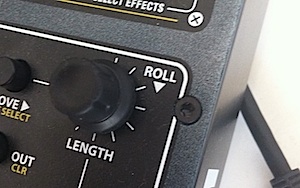
The Xone:DX with Serato ITCH has a loop roll feature allowing you to use loops while the track continues to play unaffected in the background, ready to drop in again when you're finished.

Watch out for: You need to practise this to make sure it actually sounds good, and you also have to get your timing right for the drop out and the changes.
Also, when you release a loop, it will usually begin playing from the part of the song where you pressed "loop", which may not be where you would want, especially if you're using this technique for the common / cliched use of getting out of a break while adding a bit of excitement to the mix. Two ways round this last point. The first is a hack: You set a cue point for the first beat after the break, do your loop, then hit the cue point when you're done, so the track carries on playing from where you ideally would have wanted the loop to release it.
The second is to use any dedicated "loop roll" function that your software offers you. For instance, in Serato ITCH with a Xone:DX, there's loop roll feature whereby you loop as above, but the track carried on playing as if you weren't messing around with it in the background, unheard. The second you drop out of the looping, the track kicking in again where it wouldn't have been had you not started the loop section at all.
Don't do this too often, and don't do it for the sake of it on a break that has perfectly enough excitement as it is - it'll annoy people. There's skill involved here, too, so practise it at home, not in front of the audience.

Another thing


Looping works best when you can't tell you're listening to a loop. Watch out for musical phrases that start and get clipped off as the loop returns to the front, or instruments being slowly removed from the mix that then jump back up in volume as the section loops.
Sometimes you can get round these problems by not starting your loop bang on the beat instead starting it at the start of a musical phrase that happens to start somewhere else in the bar, but the key is to listen to the loop. If it sounds looped, it's not good.

Credit:- http://www.digitaldjtips.com

Read »

Copyright © Essential Tips and Tricks

Designed by